By ACCESS · Last updated: October 2, 2026 · Figures current as of October 2, 2026
If you run benefits for a workforce of part-time, shift and hourly employees, the 2027 renewal is arriving with the largest projected employer health insurance cost increase in years. This guide pulls together what the public 2027 projections say, how benefit access and cost differ for part-time and lower-wage staff, a checklist of questions to take to your benefits advisor, and a renewal worksheet.
About this guide. ACCESS publishes this guide. ACCESS is a healthcare access membership, not insurance, and it doesn't replace an employer's health plan. This guide is general information, not legal, tax or benefits advice. Take plan, eligibility and compliance decisions to your licensed benefits advisor, broker or tax professional.
2027 at a glance
| Item | Figure | Status as of Oct 2, 2026 | Source |
|---|---|---|---|
| Projected total health benefit cost per employee, 2027 | +8.2% after planned cost-reduction measures; +11% if employers took no action | Preliminary survey results (1,800+ employers); final results due later in 2026 | Marsh (Mercer), Sep 2, 2026 |
| Projected employer health cost trend, 2027 (large employers) | 9.2% median; 8% after plan design changes | Survey of 127 large employers, completed June 2026 | Business Group on Health, Aug 25, 2026 |
| Projected employer health care cost increase, 2027 | 9.5%, status quo before mitigation; average costs "above $19,000 per employee" | Projection from Aon's client database | Aon, Aug 20, 2026 |
| Average annual premiums, employer coverage | $9,325 single; $26,993 family (2025). Worker contributions: $1,440 single / $6,850 family | Latest edition available as of October 2026. | KFF, 2025 EHBS |
| Employer benefit costs per hour worked, private industry (June 2026) | Part-time: $5.05 of $25.20 total compensation (20.0%). Full-time: $17.03 of $54.00 (31.5%) | Latest quarterly release | BLS, Employer Costs for Employee Compensation, June 2026, Table 5 |
The three 2027 projections measure different things (cost per employee after planned changes, a median cost trend for large employers, and a status-quo projection) and come from different employer samples. They aren't directly comparable, and we don't combine them.
Figure 1. Three public 2027 employer cost projections
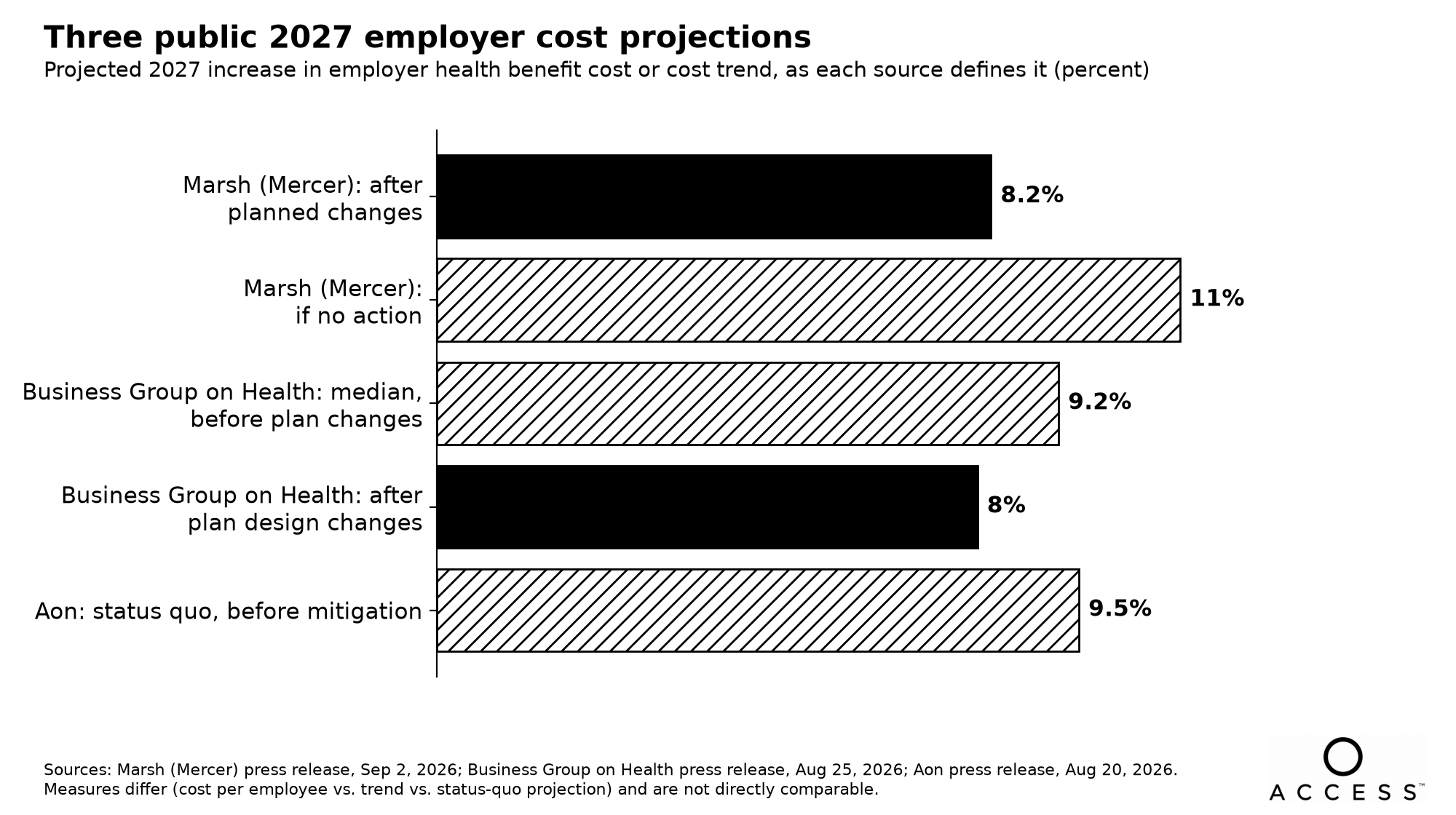
Data for Figure 1:
| Source and measure | 2027 projection (%) |
|---|---|
| Marsh (Mercer): total cost per employee, after planned changes (preliminary) | 8.2 |
| Marsh (Mercer): if employers took no action (preliminary) | 11 |
| Business Group on Health: median trend for large employers, before plan changes | 9.2 |
| Business Group on Health: after plan design changes | 8 |
| Aon: status quo, before mitigation | 9.5 |
Sources: Marsh (Mercer), Sep 2, 2026 (preliminary); Business Group on Health, Aug 25, 2026; Aon, Aug 20, 2026. The projections measure different things and aren't directly comparable.
1. How big is the employer health insurance cost increase for 2027?
The public projections all point to a bigger increase than in recent years, driven by the same pressures:
- The largest jump in two decades. Marsh (Mercer) calls its 8.2% projection "the highest increase since 2003," compared with an average projected increase of 6.7% for this year. Its figure is preliminary. Source: Marsh (Mercer). Business Group on Health reports a 2026 median trend of 8.5% among large employers, potentially reduced to 7% after plan changes. Source: BGH.
- Pharmacy and GLP-1 medications. Marsh (Mercer) estimates that "rising GLP-1 utilization accounts for a full percentage point of the overall cost growth for 2027." Business Group on Health says pharmacy now represents 25% of employers' total healthcare spend, and that employer drug costs are estimated to rise 12% in 2026.
- Prices and claims. Marsh (Mercer) cites advances in diagnostics and therapeutics, health system consolidation, lower government funding and reimbursements in public programs, AI-enabled billing software that has led to more and higher-level claims, and payments to out-of-network providers through the No Surprises Act's dispute-resolution process. Source: Marsh (Mercer).
- Employees already carry a large share. Aon expects the average employee to pay $5,297 for health care in 2026: $3,130 in paycheck contributions plus $2,167 out of pocket. Source: Aon.
2. What employers are planning, and why hourly teams feel it first
- Plan-design changes are common. 59% of employers in Marsh's survey plan cost-cutting changes to health benefits in 2027, "including plan design changes like higher deductibles that can increase members’ out-of-pocket costs." About two-thirds of large employers (500+ employees) expect to raise employees' share of premium costs. Over a third of large employers plan to offer a non-traditional medical plan in 2027, such as a variable copay or high-performance network plan. Source: Marsh (Mercer).
- Deductibles are already high for many. In 2025 the average single-coverage deductible was $1,886 ($2,631 at firms with 10 to 199 workers), and 34% of covered workers had a single deductible of $2,000 or more (53% at firms with 10 to 199 workers). Source: KFF, 2025 EHBS (latest edition available as of October 2026).
- Premium shares are heavier at lower wages. In private-industry family coverage, employees in the lowest 25% wage category paid 37% of the premium, compared with 28% in the highest 25% category. Source: BLS, Employee Benefits in the United States, March 2026, Table 4. At small firms (10 to 199 workers), the average worker contribution for family coverage was $8,889 in 2025. Source: KFF.
- Primary care is getting attention. 60% of Business Group on Health respondents report "elevating prevention and primary care." Source: BGH.
3. What benefits cost per hour for part-time and hourly workers
BLS's Employer Costs for Employee Compensation shows how differently benefit dollars flow to part-time and full-time staff in private industry (June 2026):
| Private industry, June 2026 | Total compensation per hour worked | Wages and salaries | Benefits | Benefits as share of compensation |
|---|---|---|---|---|
| Full-time workers | $54.00 | $36.97 | $17.03 | 31.5% |
| Part-time workers | $25.20 | $20.15 | $5.05 | 20.0% |
Source: BLS, Employer Costs for Employee Compensation, June 2026, Table 5.
In leisure and hospitality, total employer compensation averaged $27.95 per hour worked for full-time workers and $17.21 for part-time workers. Same source.
4. Part-time and lower-wage access to employer medical benefits
- Access follows hours. 23% of part-time private-industry workers had access to employer medical care benefits in March 2026, compared with 87% of full-time workers. Source: BLS, Employee Benefits in the United States, March 2026.
- Few large employers extend the plan to part-time staff. 27% of firms with 200 or more workers that offer health benefits offered them to part-time workers in 2025. Firms with 200 or more workers were much more likely than smaller firms to offer health benefits at all (97% vs. 59%). Source: KFF, 2025 EHBS.
- Eligibility is narrower where wages are lower. Workers at firms with many lower-wage employees had a 67% average eligibility rate, compared with 83% at other firms. Same source.
For the data on schedules, coverage and everyday-care barriers for hourly workers, see our companion brief, Irregular Schedules and the Care-Access Gap.
5. Options for hourly teams: adding everyday-care access beside the plan
Many employers are looking at ways to help people reach everyday care that sit beside the medical plan. Among firms with 50 or more workers that offer health benefits, 30% contract for virtual primary care services beyond their health plan networks, and 7% contract directly with an organization for primary care. Source: KFF, 2025 EHBS.
Common approaches (general; not an endorsement of any type or vendor):
| Approach | What it is | Questions to ask |
|---|---|---|
| Plan-based telehealth | Virtual visits offered through the medical plan | Who's eligible? Is there a per-visit cost before the deductible? |
| Employee assistance program (EAP) | Short-term counseling and referral support | Is it offered to part-time staff? What hours and languages? |
| Onsite or near-site clinic | Employer-sponsored clinic at or near the worksite | Do clinic hours match shift patterns? |
| Direct contracts for primary care | Employer contracts with a primary care organization | How does it work alongside the plan? |
| Care-access membership | A membership, separate from the health plan, that gives employees (and sometimes households) a way to reach clinicians for everyday, non-emergency needs | Is it insurance? (ACCESS isn't.) What's included and what costs extra? Which household members can use it? What's the emergency instruction? |
| Scheduling and time policies | Shift-swap rules, earlier schedule notice, time for appointments | Can someone attend a one-hour appointment without losing a shift? |
For any option, ask:
- Reach: Can part-time, night and weekend staff use it, by phone as well as video, in the languages your teams speak?
- Scope: What's included, what costs extra, and what still goes through the medical plan?
- Fit: How does it fit with your plan documents and compliance obligations? Take that question to your benefits advisor or tax professional. This guide doesn't answer it.
- Safety: Does it clearly tell people to call 911 for emergencies?
- Privacy: Will any health information reach the employer?
More on options for part-time and hourly employees: ACCESS for employers.
6. How ACCESS fits (about the publisher of this guide)
ACCESS publishes this guide. Here is how its membership fits beside an employer's existing benefits, using only what the ACCESS website publishes:
- What it is: ACCESS is a membership for healthcare access services, not an insurance plan, and it does not replace health coverage. Source: accessghl.com/faqs. Your medical plan stays as it is. ACCESS sits beside it. For more, see healthcare membership vs. insurance.
- Who it's for at work: "one membership that helps associates reach everyday virtual care across shifts, schedules, and locations." Source: accessghl.com/employers.
- What's included in membership: virtual primary care, urgent care, dermatology, care navigation, behavioral health and counseling resources, specialist messaging and network access where available, and the ACCESS portal and My Care. Labs are available at an additional cost, starting at $150. Source: accessghl.com/membership. More on virtual care.
- Clinicians: Board-certified physicians. Source: accessghl.com. Clinical decisions remain with licensed clinicians. Source: accessghl.com/employers.
- Published prices (membership, not insurance): ACCESS Individual is $79/month for one member. ACCESS Family is $229/month for the primary member plus up to 7 additional family members (8 total). Labs are extra, starting at $150. ACCESS is a membership, not insurance. Sources: accessghl.com/faqs; accessghl.com/membership.
- For employer groups: eligibility, contribution, enrollment and billing are set in each employer's written membership agreement.
- Not emergency care: ACCESS does not provide emergency services. Call 911 or go to the nearest emergency department in an emergency. Source: accessghl.com/faqs.
ACCESS makes no claims about what it will do to your plan costs, claims or renewal.
Talk with ACCESS about whether it fits your teams.
7. Questions to ask your benefits advisor
Take these to your licensed benefits advisor, broker or tax professional before your 2027 renewal. They're questions only. This guide doesn't answer them.
Variable-hour measurement
- How should we measure hours for employees whose schedules change week to week, and does our current method still fit our workforce?
- When does a newly hired variable-hour or seasonal employee get a plan offer, and how long do they wait?
- How do we count hours for people who work more than one role or location?
- What records do we need to keep, and who owns them?
Affordability
- Is our lowest-cost employee-only option affordable for the 2027 plan year under the rules that apply to us, and which method should we use to check it?
- If our plan year doesn't start in January, which year's figures apply to us, and when?
- How would the 2027 contribution changes we're considering affect that answer?
Eligibility
- Which employee groups are eligible for the medical plan today, and are those rules written down and applied consistently?
- Does our current eligibility approach fit our obligations, given our size and workforce mix?
- What happens to someone's eligibility when their hours rise or fall during the year?
- What do employees who aren't eligible for the plan receive today, and do they know about it?
Adding a benefit beside the plan
- If we add a non-plan benefit such as a care-access membership, how does it fit with our plan documents, COBRA and any HSA-eligible plan? Who should review it?
- Do any notices, reporting or tax steps apply to an employer contribution toward it?
8. 2027 renewal worksheet for hourly teams
Copy this into a spreadsheet. Fill in your own numbers, and leave a cell blank rather than guess.
A. Workforce map
| Item | Your figure |
|---|---|
| Total employees (headcount) | |
| Employees currently eligible for the medical plan | |
| Employees whose weekly hours vary | |
| Employees working mostly evenings, nights, weekends or rotating shifts | |
| Roles that can't be done from home | |
| How hours are tracked for benefits today (confirm with your advisor) |
B. Cost inputs
| Item | Your figure |
|---|---|
| 2026 total plan cost per enrolled employee | |
| 2027 renewal increase quoted by your carrier or administrator | % |
| Public projections for comparison: Mercer 8.2% (after changes, preliminary) / BGH 9.2% median (large employers) / Aon 9.5% (status quo) | (reference only) |
| Employee monthly contribution, lowest-cost employee-only option | $ |
| Single deductible on the most-enrolled plan | $ |
Sources for reference figures: Marsh (Mercer), BGH, Aon.
C. Eligibility and access
| Question | Answer |
|---|---|
| What do employees who aren't eligible for the plan get today? | |
| Can a night-shift employee reach a clinician for a non-emergency question during their off-hours? | |
| Can an on-site employee attend a one-hour appointment without losing pay or a shift? | |
| How far ahead are schedules posted? | |
| Are everyday-care options listed in one place, in the languages your teams use? | |
| Does every benefit communication include "In an emergency, call 911"? | |
| Advisor questions in section 7 answered and filed? | Yes / No |
D. Decisions and owners
| Decision | Owner | Date |
|---|---|---|
| Plan-design changes for 2027 (deductibles, contributions), reviewed with your advisor | ||
| Eligibility rules for part-time and variable-hour staff, reviewed with your advisor | ||
| Any added everyday-care access option, reviewed with your advisor | ||
| Open enrollment communications for hourly staff |
FAQ
How much will employer health costs rise in 2027? Public projections range from 8.2% (Marsh/Mercer, preliminary, after planned changes) to a 9.2% median trend among large employers (Business Group on Health) and 9.5% in a status-quo scenario (Aon). Each measures something different, so they aren't directly comparable. (Mercer; BGH; Aon)
What does employer health insurance cost per employee? In KFF's 2025 survey, average annual premiums were $9,325 for single coverage and $26,993 for family coverage, with workers contributing $1,440 and $6,850 on average. KFF's 2026 survey hadn't been published as of October 2, 2026. (KFF)
What do benefits cost per hour for part-time workers? In June 2026, employer benefit costs for part-time private-industry workers averaged $5.05 per hour worked, 20.0% of total compensation of $25.20. For full-time workers, benefits averaged $17.03, or 31.5% of $54.00. (BLS)
Do part-time workers get employer medical benefits? Less often. In March 2026, 23% of part-time private-industry workers had access to employer medical care benefits, compared with 87% of full-time workers. Which employees your plan must or should cover is a question for your benefits advisor. (BLS)
What should we ask our benefits advisor before the 2027 renewal? Ask your benefits advisor how you should measure hours for variable-hour staff, whether your lowest-cost option is affordable for 2027, who is eligible and how that's documented, and how any added benefit beside the plan fits your plan documents. Section 7 has the full checklist. This guide doesn't answer those questions.
Is ACCESS a health plan? No. ACCESS is a care membership, not insurance. ACCESS is a membership for healthcare access services, not an insurance plan, and it does not replace health coverage.
This guide is general information, not legal, tax or benefits advice. Figures are quoted from the public sources linked and were current as of October 2, 2026. ACCESS is a membership, not insurance, and it is not emergency care. In an emergency, call 911.
Suggested citation
ACCESS (2026). The 2027 Benefit-Cost Guide for Employers With Hourly Teams. https://accessghl.com/blog/2027-benefit-cost-guide-hourly-teams
Reuse: Free to reuse with credit to ACCESS (accessghl.com) and the original data source.
Sources
- Marsh (Mercer). "Employers expect health benefit costs to jump 8.2% in 2027, and the impact will likely be felt by workers, according to Marsh." Sep 2, 2026 (preliminary results). https://www.mercer.com/en-us/about/newsroom/employers-expect-health-benefit-costs-to-jump-in-2027/
- Business Group on Health. "Cost Volatility Forces Employers To Reassess Healthcare Strategy, Business Group on Health Survey Reveals." Aug 25, 2026. https://www.businessgrouphealth.org/newsroom/news-and-press-releases/press-releases/2027-employer-healthcare-strategy-survey
- Aon. "Aon: U.S. Employer Health Care Costs Continue Multi-Year Climb, Projected to Rise 9.5% in 2027." Aug 20, 2026. https://aon.mediaroom.com/2026-08-20-Aon-U-S-Employer-Health-Care-Costs-Continue-Multi-Year-Climb,-Projected-to-Rise-9-5-in-2027
- KFF. 2025 Employer Health Benefits Survey. Oct 22, 2025 (latest edition available as of October 2026). https://www.kff.org/health-costs/2025-employer-health-benefits-survey/
- U.S. Bureau of Labor Statistics. Employee Benefits in the United States, March 2026 (USDL-26-1534, Sep 25, 2026). https://www.bls.gov/news.release/ebs2.nr0.htm; Table 4 https://www.bls.gov/news.release/ebs2.t04.htm
- U.S. Bureau of Labor Statistics. Employer Costs for Employee Compensation, June 2026 (USDL-26-1494, Sep 9, 2026). https://www.bls.gov/news.release/ecec.nr0.htm; Table 5 https://www.bls.gov/news.release/ecec.t05.htm
- ACCESS. Membership, FAQs and Employers pages (live, Oct 2, 2026). https://accessghl.com/membership · https://accessghl.com/faqs · https://accessghl.com/employers